
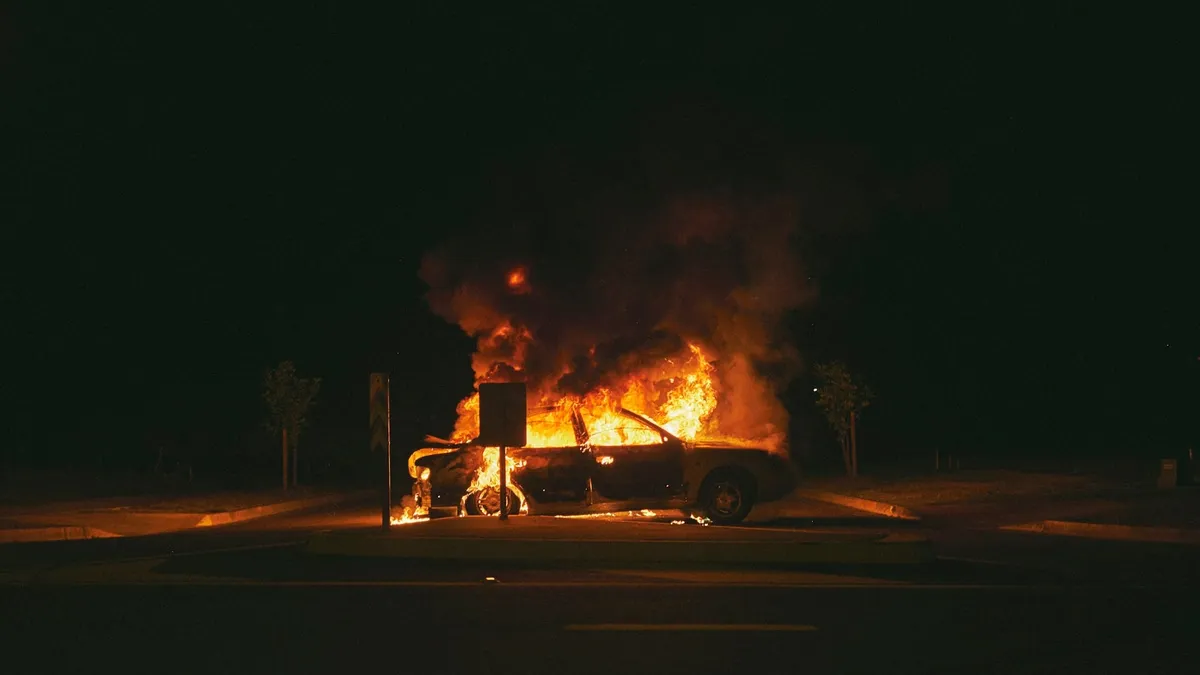
Does Car Insurance Cover Fire Damage? Coverage Guide
Does car insurance cover fire damage? The practical answer usually depends on two key things: what caused the damage and which coverages were active on the loss date. Comprehensive covers fire and other listed non-collision damage to your vehicle. Collision covers damage from a collision. Liability coverage pays for damage you cause to other people's property, not damage to your own car [1].
That distinction matters when the scene is frightening and the cause is still unknown. You do not need to diagnose an electrical fault beside a smoking vehicle. Get people to safety, report only what you observed, and let the fire and claim investigations establish the cause.
This guide gives you a safe order of operations: identify the relevant coverage, preserve evidence, compare the insurer's estimate with an itemized repair estimate, and ask for a written explanation when damage or coverage is omitted. Your declarations page and policy remain the final documents for your claim.
Does car insurance cover fire damage? Start with the cause
Use the cause category, not the size of the flames, to find the likely coverage path. The National Association of Insurance Commissioners places fire under comprehensive coverage and defines collision as coverage for damage from a collision [1].
| Question to ask | Coverage to check | What to verify |
|---|---|---|
| Was the vehicle damaged by a collision? | Collision | Whether collision was active and what the policy says |
| Was the vehicle damaged by fire without a collision? | Comprehensive | Whether comprehensive was active and what the policy says |
| Did your vehicle damage someone else's property? | Property-damage liability | Fault, limits, and the other property involved |
| Do you need towing or a temporary vehicle? | Separate towing or rental coverage | Whether each optional coverage appears on the declarations page |
Last updated: August 2026 [1]
Do not use “full coverage” as your answer. It is not one coverage line. Open the declarations page and look for comprehensive, collision, property-damage liability, each deductible, and any separate towing or rental coverage. The comprehensive versus collision guide provides a broader comparison.
Say a parked car is damaged by fire and no crash occurred. The first question is whether comprehensive appears on the declarations page, not whether the damage looks severe. If a crash occurred before the fire, tell the adjuster the sequence without choosing the coverage yourself.
Reviewing your protection before a loss? Compare policies with the same coverages and deductibles so a lower price does not hide a different level of protection.
How does car insurance cover fire damage from different origins?
A vehicle fire can begin with mechanical or electrical trouble, a crash, or another event. The U.S. Fire Administration identifies mechanical and electrical failures and collisions as common vehicle-fire causes [2]. That safety guidance identifies possible origins; it does not decide whether your policy covers a particular loss.
For a fire with no known collision, ask the adjuster whether the claim is being evaluated under comprehensive coverage. For damage tied to a collision, ask whether collision coverage is being evaluated. If someone else may have caused a crash, give the insurer the other driver's and police information and ask which claim routes are available. Do not assume another party's coverage or payment before fault and policy facts are reviewed.
Mechanical or electrical language deserves special care. A component failure can explain how the fire began, but this guide cannot establish how your contract treats that component or every item damaged afterward. Ask for the cause finding, the coverage provision being applied, and any exclusion the insurer believes controls the decision. Remove guesswork from the conversation.
Keep every explanation in writing. Ask who documented that finding and when.
Imagine the repair shop says a starter area burned while the fire investigator has not identified the origin. Avoid rewriting that uncertainty as “the starter caused it.” Preserve both records, provide them to the adjuster, and ask what additional inspection is needed. If a warranty or manufacturer process may apply, ask the adjuster, repair shop, and manufacturer whether parts need to remain available for inspection.
What to do if your car catches fire
Your first task is getting away from the vehicle, not collecting claim evidence. The U.S. Fire Administration tells drivers to pull over when safe, turn off the engine, get everyone out, move at least 100 feet away, stay out of traffic, call 911, and never return to a burning vehicle [2]. It also warns against opening the hood or trunk because added air can make the fire larger.
Follow this sequence:
- Stop safely and shut off the engine. Use the nearest location that lets occupants exit away from moving traffic.
- Get every person out. Leave phones, bags, and other property behind.
- Move at least 100 feet away. Keep people away from traffic and the burning vehicle.
- Call 911. Give the dispatcher your location and describe what you can see from a safe distance.
- Stay out. Do not open the hood or trunk, fight the fire, or return for belongings [2].
Wait for first responders to control the scene completely before approaching. Ask the responding agency how to obtain its incident record, if one is created, but do not delay safety actions while trying to gather paperwork. When authorities permit, record the agency name, tow destination, and the vehicle's location.
Ask the fire department, towing operator, and insurer whether the vehicle must remain untouched before an inspection and what can be done safely. Follow their directions rather than testing the vehicle merely to see what still works. Request written instructions if the next step remains unclear.
How to file and document a car fire insurance claim
Once the scene is safe, build a factual record. The Texas Department of Insurance advises consumers to file a claim as soon as possible, take photos and videos, prevent further damage when safe, keep receipts, and cooperate with the adjuster's inspection [3]. Those are practical documentation steps, not a guarantee that a particular expense or loss is covered.
1. Report what you observed
Use the claim contact listed by the insurer. Give the date, location, whether the car was moving or parked, whether a collision happened, the first sign you noticed, and which agencies responded. Say “cause unknown” when that is true.
2. Preserve records and images
Photograph the vehicle and surrounding scene only when authorities allow access. Save the claim number, incident-record information, tow invoice, storage location, maintenance records, recent repair invoices, purchase documents, and lender or lessor contact details. Keep a dated communication log.
3. Arrange inspection before disposal
Give the adjuster access to the vehicle and ask whether another specialist needs to inspect it. Ask whether the vehicle or damaged parts must remain untouched before work begins or until that inspection is complete. Confirm in writing where the vehicle should be stored and who can authorize a move.
4. Separate the property lists
Create one list for the vehicle and permanently attached equipment, then a separate list for loose belongings. Photograph and inventory each item without assigning it to an insurance policy yourself. Ask each potentially relevant insurer which contract, if any, it wants you to submit the list under.
5. Keep expense records
Save receipts for towing, storage, temporary transportation, and other loss-related spending. Ask whether the policy provides the relevant benefit and what limit or approval rule applies before assuming reimbursement. NAIC describes towing and rental reimbursement as separate coverages [1].
This file makes later questions easier to answer. It also reduces the risk that a changing memory becomes the only record of what happened.
Compare the insurer's estimate with omitted damage
An estimate is a line-by-line starting point, not a reason to argue from a single total. Texas regulators tell consumers to compare the insurer's estimate with the repair estimate, discuss differences, remember the deductible, and ask the insurer to explain a rejected claim [3].
Use this workflow:
- Request the insurer's itemized estimate or valuation. Keep the version date and every page.
- Get an itemized shop estimate. Ask the shop to identify operations, parts, labor, and damage it can document.
- Compare matching lines side by side. Mark damage, parts, labor operations, or necessary inspections that appear in one document but not the other.
- Attach evidence for each difference. Use labeled photos, diagnostic notes, measurements, invoices, or the shop's written explanation.
- Send the comparison in writing. Ask whether the insurer needs a reinspection, additional estimate, or other documentation to evaluate each omitted item.
- Request a written response. If the insurer rejects the claim, ask for the reason in writing [3]. If it omits or declines an individual item, request a written explanation. Separately, request the policy language applied to either decision.
For example, suppose the insurer's estimate lists exterior fire damage while the shop documents heat damage to wiring behind a panel. Do not write only “the estimate is too low.” Identify the omitted inspection or operation, attach the shop's documentation, and ask the adjuster to address that line.
The deductible is part of the comparison, but it should not hide an incomplete scope. TDI explains that a deductible is subtracted from the amount the insurer pays under your policy [3]. Our guide to how a car insurance deductible works can help you read that calculation.
After the urgent claim work is stable, compare future options on matching terms. Keep the same limits, coverages, and deductibles in every comparison.
Repairable fire damage versus a total loss
A burned vehicle is not automatically a total loss. TDI says an insurer will likely consider it totaled when repairs cost about the same as or more than its value, while some companies may use a lower repair cost [4]. Rules and claim decisions vary, so ask the adjuster for the calculation used in your specific claim.
If the vehicle is declared a total loss, request the valuation information. TDI recommends asking which source the insurer used, searching local listings for comparable vehicles, and documenting special features or custom parts [4]. Compare the listed year, trim, mileage, options, condition adjustments, and local comparables with your records.
Keep valuation and repair scope as separate questions. A repair estimate asks what work is needed and what it may cost. A valuation asks what the vehicle was worth before the loss. If either document omits a material fact, identify the exact field or line and submit the correction with support.
A loan or lease adds another party to the process. Ask the insurer and lender or lessor how payment and title documents will be handled. Do not assume the vehicle payment will erase the remaining balance. GAP is a separate product, according to NAIC [1], so check the GAP insurance guide and the actual agreement before drawing a conclusion.
If you disagree with the valuation, start with the evidence. The total-loss settlement guide explains how to organize comparable listings and vehicle-specific records. If a coverage or claim-handling dispute remains, the claim-denial guide outlines questions to put in writing.
What to review before another vehicle fire
A pre-loss review cannot change a loss that already happened, but it can reveal whether your current choices match the risk you can afford. Read the declarations page and policy together. The declarations page shows selected coverages and deductibles; the policy contains definitions, conditions, and exclusions.
Check these items one by one:
- comprehensive coverage and its deductible;
- collision coverage and its deductible;
- property-damage liability limits;
- towing or roadside coverage;
- rental reimbursement;
- listed custom equipment or endorsements;
- GAP from an insurer, lender, or dealer; and
- lender or lease requirements.
Then ask a practical question: could you replace the vehicle if a non-collision fire destroyed it? A driver with an older paid-off car might accept that risk, while another driver who relies on the car for work might not. That is a budgeting decision, not a universal coverage formula.
Use related cause guides to test the same declarations page from different angles. The articles on vandalism coverage and flood-damage coverage show why comprehensive decisions should be made with several non-collision risks in mind.
Check your jurisdiction separately. Use the state requirements table and state auto-rules directory as starting points, then confirm the current rule with the regulator and your policy documents.
If you shop, copy the current limits and deductibles into a comparison worksheet. Review exclusions and optional benefits rather than comparing premium alone. The cheapest offer is not necessarily equivalent if it changes the protection you intended to buy.
Save the current declarations page, policy, and endorsements together so you can compare later changes against a dated record. Write down any questions and ask them before the renewal date. Keep the answers with the policy rather than relying on memory.
Frequently asked questions
Does comprehensive car insurance cover arson?
NAIC lists fire as a type of non-collision damage handled by comprehensive coverage [1]. For an intentionally set fire, report what happened and ask the insurer how the cause investigation, your comprehensive coverage, and the policy terms apply. Do not treat the word “arson” alone as a guaranteed claim result.
Does insurance cover wildfire damage to a parked car?
Start by checking whether comprehensive coverage was active because NAIC places fire under comprehensive coverage [1]. Then report the loss and let the insurer apply the policy to the facts. Whether the vehicle was parked does not replace the need to confirm the cause, active coverage, deductible, and contract terms.
Is an engine or electrical fire covered?
Mechanical and electrical failures are among the common causes of vehicle fires identified by the U.S. Fire Administration [2]. That cause does not settle the insurance decision by itself. Ask which coverage provision applies, what the investigation found, and whether the insurer is relying on an exclusion.
Does liability-only insurance pay for my burned car?
Property-damage liability covers damage you cause to other people's property; it is not physical-damage coverage for your own vehicle [1]. Check whether comprehensive or collision also appears on your declarations page. The cause and selected coverage determine which first-party coverage, if any, is evaluated.
Do I have to pay a deductible on a fire claim?
When a covered claim is paid under your own policy, the deductible shown for the applicable coverage is subtracted from the insurer's payment, according to TDI [3]. Check the declarations page and written claim calculation rather than assuming which deductible applies before the cause and coverage are identified.
Will a fire claim raise my premium?
This guide does not predict a pricing outcome. Ask the insurer or agent how the claim may be treated under the rating rules that apply to your policy and location. Do not delay calling 911, reporting the loss, or protecting people because you are worried about a possible future price change.
The bottom line
The answer to “does car insurance cover fire damage?” begins with the cause and the coverages that were active. Comprehensive is the coverage NAIC identifies for fire and other non-collision damage. Collision covers collision damage. Liability coverage addresses damage you cause to other people's property, not physical damage to your own vehicle [1].
This week, put the claim record in order: save the incident information, images, tow and storage documents, receipts, policy, estimates, and communication log. Compare the insurer's estimate with the shop's itemized estimate. For every omitted item, attach evidence and request a written response instead of disputing only the total.
Before the next renewal, review comprehensive, collision, deductibles, towing, rental, equipment, GAP, and any lender requirements. Match those fields when shopping so you can see whether a price difference reflects a true rate difference or different protection.
Want a clearer view of your options without changing the comparison terms? Compare matched car insurance coverage options with QuoteFii.
Sources
[1] National Association of Insurance Commissioners, “What Does Auto Insurance Cover?,” What Does Auto Insurance Cover?
[2] U.S. Fire Administration, “Vehicle Fire Safety,” Vehicle Fire Safety
[3] Texas Department of Insurance, “Steps to Getting Your Home or Car Insurance Claim Paid,” Steps to Getting Your Home or Car Insurance Claim Paid
[4] Texas Department of Insurance, “My Car Was Totaled! Now What?,” My Car Was Totaled! Now What?
This article is for informational purposes only and does not constitute insurance, financial, or legal advice. Information may contain errors or be outdated. Always verify details with a licensed insurance professional before making coverage decisions.
Compare related decisions
More guides that help put this topic in context.
Related Articles

$500 vs. $1,000 Car Insurance Deductible: Which Saves More?
Should you raise your car insurance deductible to $1,000? See the break-even math, claim frequency data, and when each option makes sense for your budget.
Mar 17, 2026 · 5 min read
Does Car Insurance Cover Engine Damage? A 2026 Guide
Car insurance may cover engine damage caused by a covered crash or event, but not ordinary breakdown. Learn how to document damage and review your policy.
Aug 17, 2026 · 13 min read
Does Car Insurance Cover Pothole Damage? Claims Guide
Does car insurance cover pothole damage? Learn when collision may apply, what damage to inspect, how deductibles work, and how public-road claims stay separate.
Aug 12, 2026 · 14 min read