
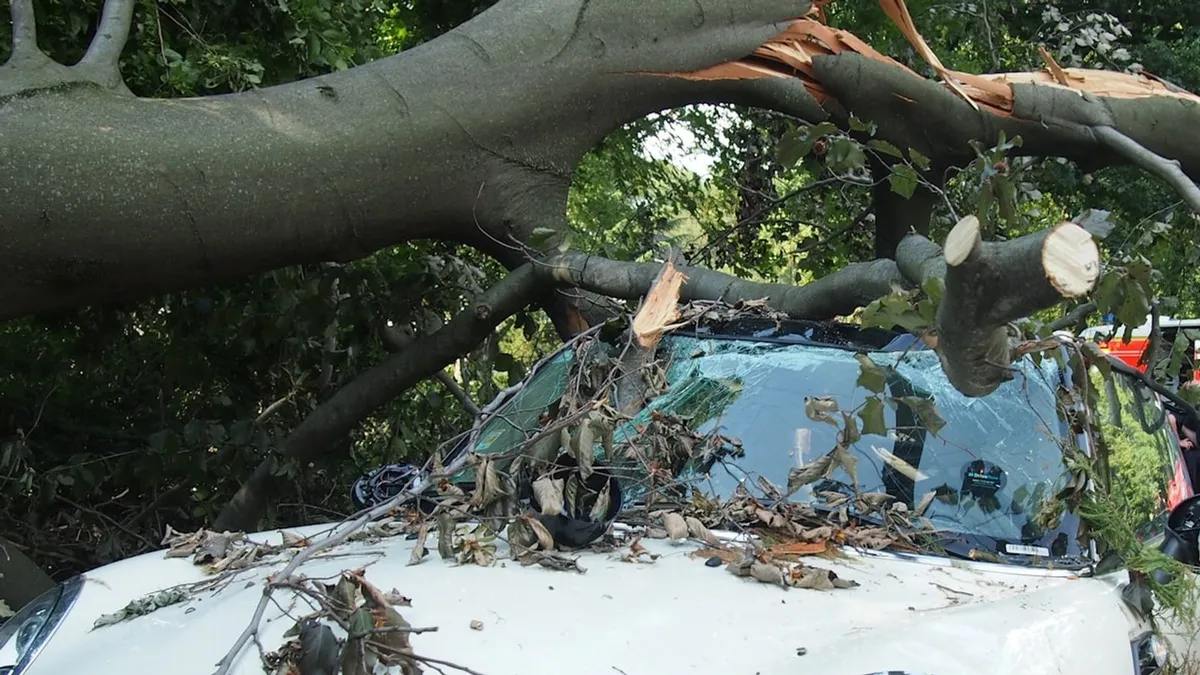
Does Car Insurance Cover Tree Damage? Claims Guide
Does car insurance cover tree damage? A tree or branch that falls onto a parked car is a non-collision event to discuss under comprehensive coverage. If you drive into a downed tree, collision coverage is the line to check because your vehicle hit an object. The policy, active coverage, event facts, and claim decision control the actual result [1].
The direction of impact matters more than who owns the tree at the start of the claim. First, keep people away from unstable limbs, traffic, and downed utility lines. Then document the scene from a safe location, open your declarations page, and report what happened without guessing why the tree failed.
This guide walks through the coverage distinction, evidence, tree-removal coordination, repair estimate, total-loss valuation, and third-party questions. It also separates practical estimate follow-up from state-specific rules about rejected claims.
You do not need to solve every coverage question at the curb. Build a reliable record first.
Does car insurance cover tree damage? Follow the event sequence
Start by describing what moved. The National Association of Insurance Commissioners defines comprehensive as coverage for vehicle damage not caused by a collision. It defines collision as coverage for damage when your car collides with another car or an object [1]. Those definitions point to different coverage questions when a tree is involved.
| What happened? | Coverage to check first | What to verify |
|---|---|---|
| A branch or tree fell onto a parked car | Comprehensive | Whether comprehensive was active, the deductible, and the policy wording |
| Your moving car struck a downed tree or standing trunk | Collision | Whether collision was active, the deductible, and the sequence of impact |
| A falling limb caused you to crash into another object | Ask the adjuster to review the full sequence | Which damage came from each event and how the policy applies |
| Your car damaged someone else's property during the event | Property-damage liability may be relevant | Fault, limits, facts, and the property involved |
Last updated: August 2026 [1]
Do not use “full coverage” as the answer. It is not a single coverage line. Look for comprehensive, collision, liability, each deductible, towing, rental reimbursement, and any endorsements on the declarations page. The comprehensive versus collision guide explains the broader distinction.
Imagine a limb drops onto a car that has been parked all night. That is different from seeing a trunk across the road and striking it while driving. Tell the adjuster which object moved, whether the car was occupied, and what happened next. Let the insurer classify the claim in writing so the question stays precise.
Before comparing outcomes, separate every impact in chronological order. Note where the car was, whether it was moving, what struck it first, and whether a later collision caused different damage. That timeline helps the adjuster match each damaged area to the event being reviewed.
Reviewing protection before a storm? Compare policies with the same coverages and deductibles so a lower price does not hide a different level of protection.
What to do when a tree or branch hits your car
Treat the location as a hazard scene before treating it as an insurance scene. A hanging limb can shift. A trunk can block traffic. A wire tangled in branches may still be energized.
Do not climb onto the vehicle, touch a wire, cut a limb, or stand under a damaged canopy to get a better photograph.
Use this sequence:
- Keep everyone clear. Move occupants and bystanders away from the vehicle, unstable branches, traffic, and utility equipment.
- Call the appropriate emergency help. Use 911 for immediate danger. Contact the utility through its emergency channel when power lines or electrical equipment may be involved.
- Photograph from a safe position. Capture the whole scene, the direction of the fallen tree, the trunk or branch, visible vehicle damage, street signs, surrounding property, and any warning tape or blocked access.
- Report the loss. Give the date, time, location, weather you observed, whether the car was parked or moving, and which agencies or property representatives responded.
- Ask before removal. Find out whether the insurer needs photographs, measurements, an inspection, or a particular removal process before the tree is moved. Safety directions from responders and utilities come first.
- Prevent additional damage only when safe. Follow written instructions about covering openings, moving the vehicle, towing, or storage. Keep every receipt.
The Texas Department of Insurance advises policyholders to photograph damage, take reasonable steps to prevent more damage, keep receipts, and respond promptly to requests for information [2]. Those practices build a clearer file. They do not guarantee that a particular expense is covered.
If crews must remove the tree immediately for safety or access, do not interfere. Ask who ordered the work, which company performed it, where debris went, and whether the crew can preserve useful photographs or measurements. Save the work order and invoice even when someone else pays the removal company.
Who pays when someone else's tree hits your car?
Tree ownership does not automatically decide payment. Your own physical-damage coverage and a possible claim against another party are separate routes. You can report the loss to your auto insurer while facts about the tree, property, maintenance, and prior notice are still being collected.
Avoid declaring that a neighbor, landlord, homeowners association, parking operator, or city was negligent. A dead-looking branch, a prior complaint, or a storm may be important evidence, but none of those facts lets this article decide legal responsibility. Applicable law, notice, maintenance duties, causation, and the evidence all matter.
Preserve what you can without confrontation:
- the property address and tree location;
- names and contact information for the owner or manager;
- photographs taken before and after the fall;
- copies of earlier emails, service requests, or written warnings;
- witness contact information;
- incident or work-order numbers;
- arborist, landscaping, or maintenance records you lawfully receive; and
- removal-company information and debris photographs.
Say you previously emailed a property manager about a split branch. Save the dated message and the reply. Do not rewrite that record as proof that the manager caused the loss. Provide it to the adjuster and ask whether the insurer needs anything else to evaluate recovery from another party.
If another insurer contacts you, keep notes and ask for requests or decisions in writing. Do not sign a release you do not understand. For a serious dispute, injury, or large uninsured loss, consider asking a licensed attorney in your jurisdiction about your options.
Keep first-party and third-party correspondence in separate folders so requests, offers, deadlines, and supporting records do not become mixed.
Build a tree-damage insurance claim file
A complete file separates the vehicle, the tree, the removal work, and your out-of-pocket expenses. Mixing everything into one photo folder makes omissions harder to identify later.
Record the scene and vehicle
Save wide photographs before close-ups when safe. Then capture the roof, pillars, glass, doors, hood, trunk, lights, body panels, wheels, and interior areas exposed to water or debris. Photograph the vehicle identification number and odometer if accessible. Do not operate a vehicle with crushed structure, broken glass, leaking fluids, warning lights, or uncertain electrical damage merely to test it.
Preserve the event record
Write a short timeline while details are fresh. Include where the car was, whether it was moving, the first sound or movement you noticed, weather conditions you personally observed, emergency calls, property contacts, removal, towing, and storage. Label conclusions as unknown when they are unknown.
Track inspection and removal
Ask who will inspect the car and whether the tree must remain in place. Save the removal scope, crew photographs, branch or trunk measurements, tow invoice, storage location, and release authorization. If the insurer uses photo estimating, ask how to submit damage that becomes visible after debris is removed.
Separate property from the vehicle
Create one list for permanently installed vehicle equipment and another for loose belongings. The NAIC consumer guide warns that auto policies may not cover equipment that is not permanently installed [3]. Do not assume which policy, if any, covers a laptop, child seat, tools, or other loose property. Photograph each item, save proof of ownership, and ask which contract should receive the list.
Keep a communication log
Record the date, person, channel, request, response, and promised follow-up for every contact. Save estimates, valuation reports, policy letters, receipts, and emails in their original form. Texas has specific claim-handling timelines described by its regulator [2], but do not apply those deadlines nationwide. Use the state insurance requirements directory to find the regulator and rules where you live.
Compare the tree-damage estimate with omitted repairs
A first estimate may be based on visible exterior damage. A tree strike can also affect roof structure, pillars, glass channels, wiring, sensors, cameras, weather seals, and water protection. Do not assume those items are damaged, but make sure qualified inspections address them when the facts support the concern.
Follow a line-by-line process:
- Request the insurer's itemized estimate. Ask for part descriptions, labor operations, labor rates, included inspections, deductible, and any notes or assumptions.
- Get an itemized repair-shop estimate. Ask the shop to separate visible damage, structural measurements, diagnostic work, glass work, corrosion protection, water-intrusion checks, and calibrations it believes are needed.
- Match the two documents. Compare the same panel, part, operation, quantity, and labor category rather than comparing only the totals.
- Mark each difference. Identify an omitted part, reduced labor operation, missing inspection, different repair method, or damage that became visible after removal.
- Attach evidence. Use photographs, measurements, scan results, manufacturer procedures, technician notes, and invoices that relate to each difference.
- Submit the package in writing. Ask whether the insurer needs a reinspection, more documentation, or direct contact with the shop.
- Request the response. If an item remains omitted, ask for the reason and the policy language or estimate basis being applied.
The Texas Department of Insurance tells consumers to compare the insurer's estimate with the repair estimate and discuss differences with the adjuster. For a claim governed in Texas, TDI says that if the company rejects the claim, it must say why in writing [2]. The item-level package above is a practical way to organize that conversation, not a promise that every requested operation will be approved.
Suppose the first estimate lists glass and exterior roof damage, while the shop documents a distorted opening and recommends measurement plus a camera-calibration check. Send the shop's specific evidence. Avoid the vague statement that “everything is ruined.” Specific differences are easier to evaluate.
Remember that the car insurance deductible can reduce a covered payment. Confirm which deductible the insurer applied and compare it with your declarations page.
After an urgent claim is stable, compare equivalent coverage options. Keep comprehensive, collision, deductibles, towing, and rental selections aligned in every quote.
Repairable tree damage versus a total loss
Repair scope and vehicle value answer different questions. A repair estimate describes the work believed necessary. A total-loss evaluation compares repair economics with the vehicle's value under the insurer's process and applicable state rules. A crushed roof does not let an article predict the outcome from a photograph.
The Texas Department of Insurance explains that an insurer may consider a car totaled when repair cost is about the same as or more than its value, and some companies may total it at a lower repair cost [4]. That is Texas consumer guidance, not a universal nationwide threshold.
If the vehicle is declared a total loss, request the valuation report and check:
- year, make, model, trim, and drivetrain;
- mileage and condition adjustments;
- factory options and permanently installed equipment;
- prior damage shown in the report;
- comparable vehicles, dates, locations, and equipment; and
- taxes or fees addressed under the applicable process.
Correct factual errors with documents and relevant comparable vehicles. The Texas regulator advises asking what source the insurer used and providing dealer quotes or online prices when you believe the vehicle is worth more [4]. The total-loss settlement guide gives a fuller review checklist.
A loan balance is separate from vehicle value. The NAIC guide states that auto insurance does not automatically pay a loan shortfall when market value is less than the amount owed [3]. Ask the lender for the payoff amount and review any separate GAP coverage. Do not stop making required payments unless the lender gives different instructions.
For a claim governed in Texas, if the insurer rejects the claim, it must say why in writing [2]. If another dispute remains unresolved, request the decision and policy basis in writing. Keep the evidence packet intact before using the options in the claim-denial guide.
Review coverage before the next storm
Tree damage is one reason to review comprehensive coverage, but it should not be evaluated alone. Comprehensive addresses non-collision damage under its terms. Collision addresses crashes.
The NAIC lists towing and rental reimbursement as optional coverage choices [1]. Check the declarations page and policy wording to see whether you selected either one and what the contract provides.
Use a renewal worksheet with these fields:
- comprehensive selected or declined;
- comprehensive deductible;
- collision selected or declined;
- collision deductible;
- towing or roadside benefit and limit;
- rental reimbursement and limit;
- glass terms;
- custom equipment endorsement;
- lender or lessor requirements; and
- named drivers, garaging address, and vehicle use.
Keep the fields identical when comparing prices. A quote can look cheaper because a deductible increased or an optional benefit disappeared. Review the actual declarations pages rather than a “full coverage” label.
Before changing a selection, write down the tradeoff you are accepting. A higher deductible shifts more of a covered loss to your emergency fund. Removing towing or rental support can create a separate transportation problem while the car is inspected or repaired. Keeping those choices visible makes the comparison more useful than a monthly price alone.
Think about how you use the car. Someone with a paid-off older vehicle may weigh the car's value, deductible, and emergency savings differently from a driver who depends on a financed vehicle for work. Neither situation creates a universal answer.
Storm risks also overlap. Read the focused guides to hail damage and vandalism if those events matter where you park. Compare the complete protection package before changing one coverage line.
Does car insurance cover tree damage? Frequently asked questions
Does comprehensive cover a tree branch falling on a parked car?
A branch falling onto a parked car is a non-collision event to discuss under comprehensive coverage [1]. Confirm that comprehensive was active, review the deductible and policy terms, and document the direction of impact. For a claim governed in Texas, if the insurer rejects the claim, it must say why in writing [2].
What if I drive into a tree lying across the road?
Collision is the coverage to check because the moving vehicle collided with an object [1]. Report the full sequence, including visibility, any earlier falling limb, other impacts, and damage to other property. The insurer will apply the policy to the facts.
Does the neighbor have to pay when their tree hits my car?
Tree ownership alone does not establish responsibility. Preserve the property address, photographs, witness details, prior written notices, and maintenance records you lawfully receive. Report the loss to your auto insurer and ask how possible recovery from another party will be evaluated.
Should I remove the tree before the adjuster sees the car?
Safety orders come first. When removal is not immediately required, ask the insurer what photographs, measurements, or inspection it needs before work begins. If emergency crews must move the tree, save the order, crew information, photographs, work scope, and invoices.
Can tree damage total a financed or leased car?
A financed or leased car can be totaled when the insurer's repair-versus-value process produces that result, but roof damage alone does not decide it [4]. Request the valuation report and correct factual vehicle details. Notify the lender or lessor, get the payoff amount, and review separate GAP coverage because auto insurance does not automatically pay a loan shortfall [3].
Will a tree-damage claim raise my premium?
The effect can vary by insurer, state, claim history, and other rating factors. This article does not predict a rate change. Use rates by state only as broad context, ask how the claim may be recorded, and compare equivalent quotes at renewal without reducing coverage by accident.
The bottom line
When tree damage has already happened, work in this order: protect people, record the scene from safety, describe the event sequence, report the claim, coordinate removal, and compare the insurer's estimate with qualified repair evidence. If the car may be totaled, review the valuation separately from the loan balance.
This week, put photographs, the timeline, removal records, tow and storage receipts, estimates, property contacts, and written decisions into one organized claim folder. Mark every unanswered question and send a concise follow-up.
Before renewal, replace “full coverage” with the actual lines on your declarations page. Compare comprehensive, collision, deductibles, towing, rental reimbursement, and equipment terms side by side.
If an answer is unclear, ask one question at a time: which coverage was reviewed, what fact controls the decision, and which document could resolve the gap. Clear questions create a useful record without overstating the claim.
Ready to review the next policy? Compare matching car insurance options with QuoteFii and choose from quotes that reflect the protection you intend to keep.
Sources
[1] National Association of Insurance Commissioners, “What Does Auto Insurance Cover?”
[2] Texas Department of Insurance, “Steps to Getting Your Home or Car Insurance Claim Paid”
[3] National Association of Insurance Commissioners, “A Consumer's Guide to Auto Insurance”
[4] Texas Department of Insurance, “My Car Was Totaled! Now What?”
This article is for informational purposes only and does not constitute insurance, financial, or legal advice. Information may contain errors or be outdated. Always verify details with a licensed insurance professional before making coverage decisions.
Compare related decisions
More guides that help put this topic in context.
Related Articles

$500 vs. $1,000 Car Insurance Deductible: Which Saves More?
Should you raise your car insurance deductible to $1,000? See the break-even math, claim frequency data, and when each option makes sense for your budget.
Mar 17, 2026 · 5 min read

Does Car Insurance Cover Engine Damage? A 2026 Guide
Car insurance may cover engine damage caused by a covered crash or event, but not ordinary breakdown. Learn how to document damage and review your policy.
Aug 17, 2026 · 13 min read

Does Car Insurance Cover Pothole Damage? Claims Guide
Does car insurance cover pothole damage? Learn when collision may apply, what damage to inspect, how deductibles work, and how public-road claims stay separate.
Aug 12, 2026 · 14 min read